Since 1994
+86 28 8393 0607
Since 1994
+86 28 8393 0607

Dec. 22, 2025
As global manufacturing becomes more competitive, forging plants are under pressure to increase productivity, reduce energy consumption, and improve product consistency. Many traditional heating methods—such as gas furnaces—struggle to meet these modern demands. This raises an important question: How can induction billet heating fundamentally reshape the forging process?
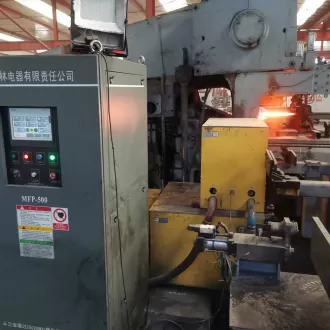
Induction billet heating works by generating heat directly inside the metal through electromagnetic induction. This eliminates the need for combustion, reduces emissions, and minimizes scale formation. As a result, forging shops experience a cleaner workspace and far more predictable heating behavior.
Precision in forging starts with temperature accuracy. Induction systems offer advantages that traditional furnaces simply cannot match:
Real-time power adjustment ensures consistent billet temperature
Uniform heating from surface to core improves material flow during forming
Minimized oxidation enhances surface quality and reduces post-processing
Lower thermal stress on tooling extends die and press life
These factors directly translate to higher-quality forged components and fewer defects.
Absolutely. Because induction delivers heat rapidly and efficiently, billets reach forging temperature much faster. This shortens cycle time and allows operators to maintain a steady, predictable rhythm of production.
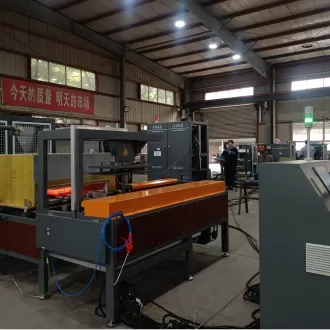
In automated plants, induction heaters can be integrated with:
Automatic billet feeders
Sorting and material-handling systems
Infrared temperature monitoring
PLC-based process control
The result is a stable, high-output line capable of operating continuously.
Induction heating is known for its high electrical efficiency. With advanced IGBT inverter technology and smart power management, energy usage can be significantly reduced compared with gas or diesel furnaces.
Manufacturers benefit from:
Lower energy bills
Reduced carbon footprint
Consistent energy consumption per billet
Better long-term cost predictability
For many plants, switching to induction pays for itself through operational savings alone.
A single induction billet heating system can handle a wide variety of metals:
Carbon steel
Alloy steel
Stainless steel
Aluminum
Copper and brass
By adjusting power, frequency, and coil configuration, operators can efficiently heat billets of different diameters and lengths. This flexibility is especially valuable in shops producing multiple product types.
Induction billet heating is rapidly becoming the preferred solution for modern forging because it supports every major industry need:
Higher throughput
Better quality control
Cleaner working environments
Lower operational costs
Easier automation integration
Long-term reliability
For companies aiming to upgrade their forging operations, induction technology is no longer an option—it is a strategic investment in future competitiveness.
Latest News
Industrial Induction Heating Applications: Which Process Is Right for Your Metalworking Operation?
Jul. 22, 2026
Industrial induction heating can be used for forging, hardening, brazing, annealing, pipe bending, shrink fitting and continuous heat treatment. Each application requires a different combination of frequency, power, coil design, material handling and temperature control.
Jul. 15, 2026
Choosing an induction heating system should begin with the workpiece and process, not with the machine’s maximum power rating. Part diameter, heating depth, target temperature, cycle time and production method all affect the final configuration.
Case Presentation
Customized Turnkey induction heating machine
Provide solution according to your requirement, well match with your production line
Related Products
Reform the Manual Production Line to Automatic
Under background of industry 4.0 and customer new request for saving the labor,full and semi-automatic production become the new trends in manufacturing industry.
Solid Sucker Rod Long Bar Two Ends Induction Hot Forge
Sucker rod used to transmit ground power to the oil pump when useing a rod pump to pump oil in oil industry. They are generally solid steel poles made of carbon steel or alloy steel, each about 8 meter long and connected with special couplings. Specially made hollow steel pipes are also used to pump oil which are called hollow oil sucker rods.
Automatic Induction Brazing for Wear-resistant Plate
The pump truck spectacle plate is a plate that looks like glasses, also known as a wear-resistant plate. It is often used in concrete pumps in the industrial field.
In 2018, we received bid for BYD auto for induction pipe bending project, they want to expand their steel structure factory for hot pipe&tube bender industry, to get new increasing profit because the order for auto industry decrease recent year.
DUOLIN Induction hardening is the most common form of induction heat treatment. It is widely used on shaft, gear, pipe .pin and other part in automotive industry.
Vehicle Parts Connection Rod Hot Forging
Induction hot forging is the most common heating application for induction heating,end hot forging for fasteners manufacture,complete billet heating for hot stamping in vehicle parts industry etc
Bearing is an important component in modern mechanical equipment. Its main function is to support the mechanical rotating body, reduce the friction coefficient during its movement, and ensure its rotation accuracy. Used in Metallurgy, wind power, mining machinery, aerospace, automotive parts industry.
Chain Hardening and Tempering Machine
Chains are generally metal links or rings, which are mostly used for mechanical transmission and traction, and are used in all industries that use chain transmission.
Induction heating is the process of heating an electrically conducting object (usually a metal) by electromagnetic induction, through heat generated in the object by eddy currents. An induction heater consists of induction power supply (induction heater) and inductor (coil) that is a shaped to contour the part, and a work station where the part is held and presented to the coil.
Quick Links
Tel.: +86 28 8393 0607
Mob.: +86 158 8242 2821
E-mail: export@duolin.com
WhatsApp: +86 158 8242 2821
Add.: 112th Hancheng Road Xindu Industrial Zone Chengdu China